View examples of the gamma-structure of prime powers for half- and quarter-factorials, and 'exceptional' prime
In the following half-factorials section the , gamma[2](2), gamma[3](2), gamma[4](2), () .. ()](images/TCD2017.mws_247.gif) are
are  := factorial(ord[`^`(p, i)](`+`(`*`(`/`(1, 2), `*`({`+`(`^`(p, i), `-`(1))}))))[p]), i = 1, 2, 3, 4, () .. ()](images/TCD2017.mws_248.gif) ,
,
and recall that, when  ,
, ](images/TCD2017.mws_250.gif) is simply the familiar
is simply the familiar , `*`({`+`(p, `-`(1))})))))](images/TCD2017.mws_251.gif) (the order of
(the order of 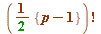 with respect to the modulus
  )
)
See the quite different behaviours of the gamma-values:
Half-factorials (just three examples to show all actual (proven) behaviours)
In the following quarter-factorials section the , gamma[2](4), gamma[3](4), gamma[4](4), () .. ()](images/TCD2017.mws_275.gif) are:
are:
 := factorial(ord[`^`(p, i)](`+`(`*`(`/`(1, 4), `*`({`+`(`^`(p, i), `-`(1))}))))[p]), i = 1, 2, 3, 4, () .. ()](images/TCD2017.mws_276.gif) ,
,
and recall that, when  ,
, ](images/TCD2017.mws_278.gif) is simply the familiar
is simply the familiar , `*`({`+`(p, `-`(1))})))))](images/TCD2017.mws_279.gif) (the order of
(the order of 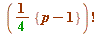 with respect to the modulus
  )
)
Quarter-factorials (just three examples to show all apparent behaviours ...)
A brief summary of what computations suggested to be true for these , gamma[2](4), gamma[3](4), gamma[4](4), () .. ()](images/TCD2017.mws_299.gif) :
:
 = `*`(gamma[1](4), `*`(p)), `*`({`+`(`*`(2, `*`(gamma[1](4))))}, `*`(p))), `*`({`+`(`*`(`/`(1, 2), `*`(gamma[1](4))))}, `*`(p)))](images/TCD2017.mws_300.gif)
 = `*`(gamma[2](4), `*`(p)), `*`({`+`(`*`(2, `*`(gamma[2](4))))}, `*`(p))), `*`({`+`(`*`(`/`(1, 2), `*`(gamma[2](4))))}, `*`(p)))](images/TCD2017.mws_301.gif)
 = `*`(gamma[3](4), `*`(p)), `*`({`+`(`*`(2, `*`(gamma[3](4))))}, `*`(p))), `*`({`+`(`*`(`/`(1, 2), `*`(gamma[3](4))))}, `*`(p)))](images/TCD2017.mws_302.gif)
etc
However, this is what a theoretical analysis uncovered, for these same , gamma[2](4), gamma[3](4), gamma[4](4), () .. ()](images/TCD2017.mws_303.gif) :
:
 = `*`(gamma[1](4), `*`(p)), `*`({`+`(`*`(2, `*`(gamma[1](4))))}, `*`(p))), `*`({`+`(`*`(`/`(1, 2), `*`(gamma[1](4))))}, `*`(p)))](images/TCD2017.mws_304.gif) OR
OR  = gamma[1](4), {`+`(`*`(2, `*`(gamma[1](4))))}), {`+`(`*`(`/`(1, 2), `*`(gamma[1](4))))})](images/TCD2017.mws_305.gif)
 = `*`(gamma[2](4), `*`(p)), `*`({`+`(`*`(2, `*`(gamma[2](4))))}, `*`(p))), `*`({`+`(`*`(`/`(1, 2), `*`(gamma[2](4))))}, `*`(p)))](images/TCD2017.mws_306.gif) OR
OR  = gamma[2](4), {`+`(`*`(2, `*`(gamma[2](4))))}), {`+`(`*`(`/`(1, 2), `*`(gamma[2](4))))})](images/TCD2017.mws_307.gif)
 = `*`(gamma[3](4), `*`(p)), `*`({`+`(`*`(2, `*`(gamma[3](4))))}, `*`(p))), `*`({`+`(`*`(`/`(1, 2), `*`(gamma[3](4))))}, `*`(p)))](images/TCD2017.mws_308.gif) OR
OR  = gamma[3](4), {`+`(`*`(2, `*`(gamma[3](4))))}), {`+`(`*`(`/`(1, 2), `*`(gamma[3](4))))})](images/TCD2017.mws_309.gif)
etc
In a pre-computer age one would have been tempted to conjecture that the second alternative (the 'OR') never held ... In fact, in the pre-computer age one might never even have arrived at conjecturing the first alternatives ...
We derived a criterion (too involved to relate here) for the second atlernative to hold, and it transpired that at the prime  , one had:
 = 14894](images/TCD2017.mws_311.gif) (which is
(which is  )
)
 = 7447](images/TCD2017.mws_313.gif) (which is
(which is  )
)
so that
 = {`+`(`*`(`/`(1, 2), `*`(gamma[1](4))))}](images/TCD2017.mws_315.gif)
and we deemed this prime to be (in this context) 'exceptional'.
Using the criterion we had obtained we tested (using Maple) to  , and then, using a very fast program written specially for us by Yves Gallot, we extended the search to
  , without finding another exceptional prime (for quarter Gauss factorials, that is).
In later years we discovered (with proof) a more beautiful (and much faster) criterion which enabled us to extend the search to  , and still no new exceptional prime (so the term 'exceptional' is well-chosen).
I shall give that test later; it came directly - and quite unexpectedly - from our extension of the Gauss binomial coefficient congruence. It's all written up in our Acta Mathematica Hungarica paper:
THE GAUSS-WILSON THEOREM FOR QUARTER INTERVALS,
Acta Mathemetica Hungarica, Vol. 142 (2014), no. 1, 199-230
You should understand that I am keeping my remarks exceptionally brief here, as there is so much more to be said.